



Hybrid vs All-Paper Deodorant Tubes: 2026 B2B Buyer’s Guide | Nextruct
Hybrid vs All-Paper Deodorant Tube Packaging (2026 B2B Buyer’s Guide)
For brand packaging and procurement teams in Europe and North America, “paper deodorant tube” is not one product. Some sticks are all-paper configurations when the full bill of materials (BOM) has no plastic components; many others are hybrid designs with a paper-led body plus a PP or PCR-PP core, base, and/or dust cover. Marketing often wants “plastic-free,” while R&D needs formula protection and a familiar dispense feel, and legal needs language that matches the actual pack.
This buyer’s guide defines hybrid versus all-paper for deodorant paper tube packaging, compares structures and claim-safe wording, and lists what to request before artwork or tooling locks. Dispensing mechanism (twist-up versus push-up) is a separate decision—see Nextruct’s companion guide on twist-up vs push-up paper tubes. Here the focus is the material stack and the claims it can support.
What “hybrid” and “all-paper” mean for deodorant tubes
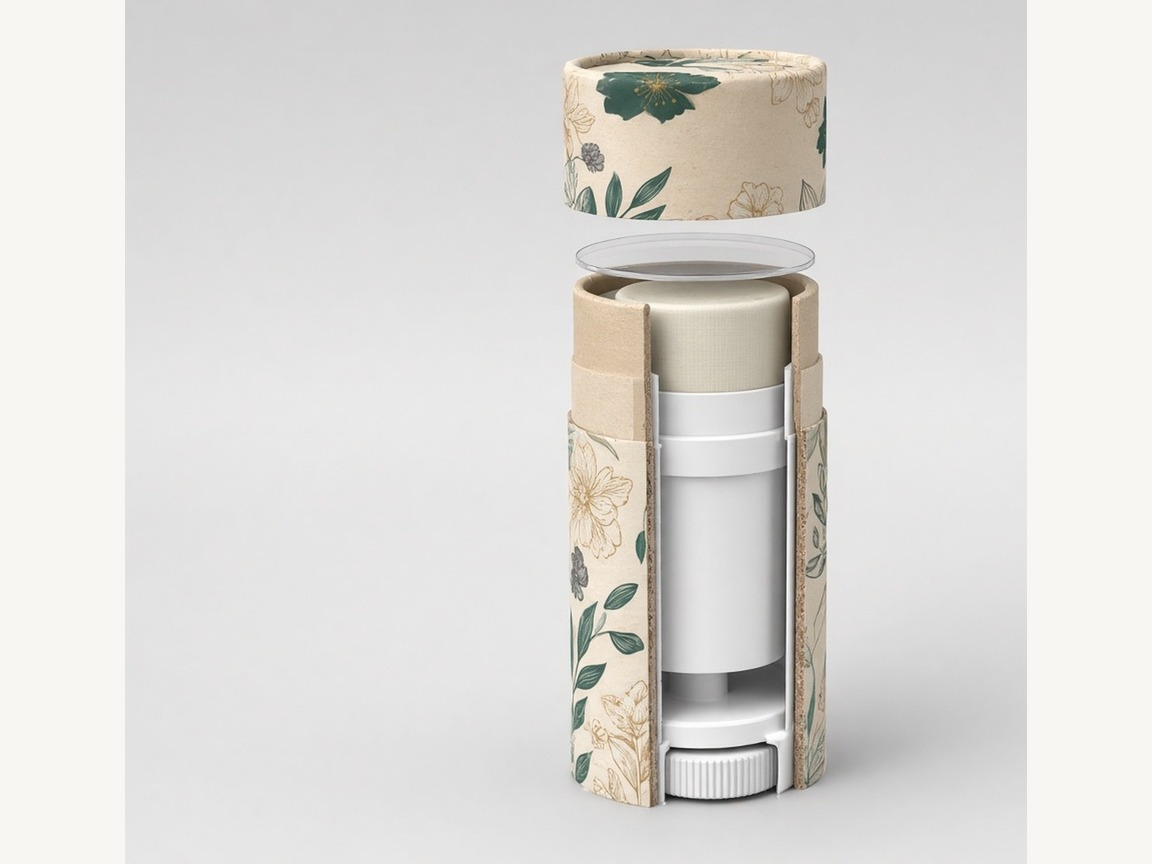
Hybrid deodorant paper tube packaging means a paper-led outer body that still includes at least one plastic component—typically a PP twist core, a PCR-PP or PP base, and/or a polymer dust cover. All-paper means every component in the approved BOM (body, push-up disc or mechanism, closure, liner, adhesives) is confirmed without plastic. A kraft or white paper outer wrap alone does not make a tube all-paper.
Buyers should compare full component lists, not shelf appearance. Until each project’s BOM is verified, treat oval and PP-containing deodorant formats as hybrid, and describe paper-only programmes as “all-paper configurations when the full BOM has no plastic components”—not as a named SKU claim.
Why brands confuse plastic-free with plastic-reduction
Public pages and consumer guides often blur “paper tube,” “plastic-free,” and “plastic reduction.” For B2B teams, those phrases are not interchangeable. If the tube includes a PP core, PCR-PP base, or polymer dust cover, honest on-pack and PDP language is plastic-reduction, reduced plastic, paper-led, or hybrid—not plastic-free.
Claim risk rises when marketing copies competitor phrasing before legal reviews the BOM. Require a component-level material breakdown for the exact configuration you will fill, ship, and label. Product catalogue copy is a starting point for specification discussion, not a project-specific performance or compliance guarantee.
Structure comparison: hybrid vs all-paper
Use the table below in RFQ conversations. Cells describe typical patterns and questions to verify—not guaranteed recyclability scores, plastic-reduction percentages, or certified outcomes for every market.
| Structure type | Typical body | Core / base / cap stack | Claim language that is usually safer | Recyclability / recovery caveats | When buyers often choose it | RFQ docs / samples to request |
|---|---|---|---|---|---|---|
| Hybrid paper deodorant tube | Paper or kraft paper-led outer wall | Often includes a PP core and/or polymer dust cover; may use a PCR-PP or PP twist base or similar functional parts | Plastic-reduction / reduced plastic / hybrid / paper-led — never plastic-free | Paper and plastic parts may need separation guidance; acceptance depends on local collection and sorting—confirm per destination market | When twist familiarity, stick control, or formula protection still needs a polymer mechanism, while the brand wants a paper-led outer story | Full BOM by component; which parts are PP / PCR-PP / paper; liner identity; filled-sample plan; claim wording legal will approve |
| All-paper deodorant tube (only when full BOM confirmed) | Paper body designed as the primary structure | Paper push-up disc / paper-led mechanism and closures only when every part is verified without plastic | All-paper / paper-led without plastic parts — only after BOM clearance; do not infer from “paper tube” alone | Liners, coatings, and adhesives still affect recovery; never claim “recyclable everywhere” | When formula, filling, and consumer ritual fit a confirmed paper-only stack and legal requires the strongest paper claim | Component-by-component confirmation that no plastic parts remain; liner/coating details; filled samples; destination-market recovery questions |
| Mechanism note (not a third material type) | Same paper-led bodies can support different dispense styles | Twist-up vs push-up is a dispensing choice, independent of hybrid vs all-paper | Describe mechanism and materials separately on RFQs and artwork briefs | N/A — see mechanism guide for use/feel trade-offs | When the team has already chosen a claim path but still needs twist familiarity or push-up simplicity | Preferred dispense feel + mechanism discussion; do not collapse both decisions into one vague “eco tube” request |
Decision criteria for Europe & North America brands
Choose by matching formula protection and dispensing expectations first, then locking claim language legal will approve, then validating recovery assumptions for the destination markets—request BOM, samples, and documents before tooling.
Formula & filling
Firm, wax-rich solids often tolerate paper-led sticks more readily than soft, oil-rich, or humidity-sensitive formulas. Treat barrier and liner needs as validation questions: which liner or coating is proposed, how the stick is filled, and what filled-sample conditions you will run. Do not assume one solid-stick structure suits every deodorant base.
Dispensing & consumer expectation
Twist-up familiarity and push-up simplicity are consumer and filling questions, not automatic proof of an all-paper or hybrid claim. Decide mechanism with engineering and marketing; decide materials with the BOM. For mechanism depth, use the twist-up vs push-up paper tubes guide rather than duplicating it here.
Claim & compliance posture
Write pack and product-page claims from the approved component list. Plastic-reduction language is usually the honest path for PP-core or PCR-PP-base programmes. Treat EU Packaging and Packaging Waste Regulation (PPWR) expectations, EPR fees, and plastic packaging tax questions as items to confirm with counsel and supplier documents for the exact configuration—not as outcomes this article can certify. Ask the supplier for current chain-of-custody and material declarations for the configuration you will buy.
End-of-life caveats
Hybrid packs may need on-pack guidance about separating paper and plastic parts where local systems require it. All-paper configurations still depend on liners, coatings, adhesives, and residue. Recovery is local: never state that a deodorant paper tube is recyclable in all European or North American systems without project-specific evidence.
Where Nextruct’s deodorant-tube range fits
Nextruct’s catalogue shows several deodorant paper tube formats rather than one interchangeable “eco” stick. Use product pages as specification starting points; confirm materials, samples, documents, and destination-market requirements for each project.
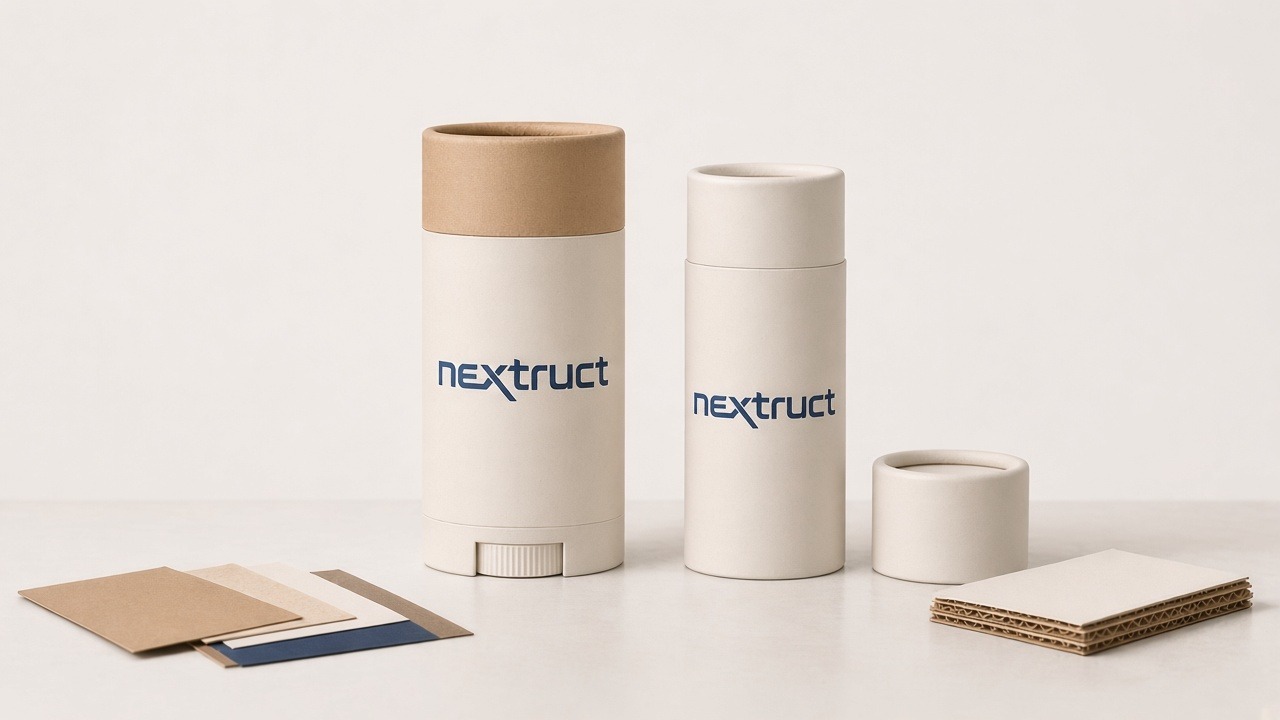
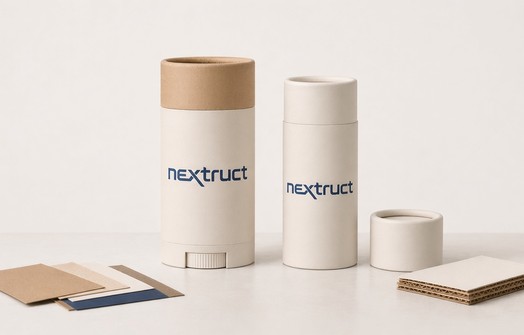
Clear hybrid illustrations include an twist-up deodorant tube with a PP core (paper-led outer with a polymer mechanism path) and a 60 g white kraft paper deodorant tube with a PCR-PP base.
Oval push-up deodorant pages help with shape and dispense discussion—for example the custom oval push-up paper deodorant stick tube and the oval paper deodorant tube with screw cap. Until project BOMs are confirmed, treat these as hybrid or claim-pending programmes in this guide: do not label them plastic-free or all-paper in brief copy. For process sequencing, see Nextruct’s note on custom paper tube packaging design and production.
Keep all-paper deodorant language in your RFQ generic—“all-paper configurations when the full BOM has no plastic components”—until a named deodorant SKU is cleared.
RFQ checklist: documents and samples to request
For a deodorant paper tube packaging project, a practical sequence is:
- State markets (EU and/or North America), formula type (firmness, oils, humidity sensitivity), preferred dispense feel, and the claim language legal will allow (plastic-reduction/hybrid vs a confirmed all-paper goal).
- Request a component-level BOM: paper body; liner/barrier identity; core; base; dust cover or cap; adhesives—and which parts, if any, are PP or PCR-PP.
- Ask for current material and chain-of-custody documents for the exact configuration under discussion, plus any project-relevant declarations your markets require.
- Plan filled samples with the intended contents, filling process, closure, and distribution conditions; track sample version so artwork and production refer to the same design.
- Confirm final BOM, claim wording, artwork version, inspection criteria, and shipment documents before production release.
Specifying hybrid versus all-paper intent up front produces cleaner supplier responses and fewer late claim conflicts.
Frequently asked questions
What is a hybrid paper deodorant tube?
A hybrid paper deodorant tube is a paper-led stick pack that still includes at least one plastic component—such as a PP core, a PCR-PP or PP base, or a polymer dust cover. Define it by the approved BOM, not by the marketing name on a catalogue page.
Can a paper deodorant tube with a PP core be called plastic-free?
No. A PP core (and often a dust cover or polymer base) means plastic remains. Use plastic-reduction, reduced plastic, paper-led, or hybrid language. Plastic-free requires a verified BOM with no plastic components.
When is “100% paper” or “all-paper” appropriate?
Only after every component—body, disc or mechanism, closure, liner, and adhesive—is confirmed without plastic for that project. Do not infer all-paper status from a paper outer wall or from the phrase “paper deodorant tube” alone.
Is hybrid always worse for sustainability than all-paper?
Not automatically. Trade-offs include formula protection, filling yield, consumer use, and real recovery routes in each market. Rank options with evidence for your SKU; avoid invented sustainability scores.
Are paper deodorant tubes recyclable in Europe or North America?
It depends on the full material stack and local collection and sorting. Hybrids and coated or lined all-paper packs need project-specific guidance. There is no blanket “yes” for all EU or North American systems.
How is this different from choosing twist-up vs push-up?
Twist-up versus push-up is a dispensing-mechanism decision. Hybrid versus all-paper is a materials and claims decision. Brands often decide both, but they should not be collapsed into one question. Use the mechanism guide alongside this materials guide.
What should we send Nextruct to start an RFQ?
Share formula type, target claim language (plastic-reduction/hybrid versus a confirmed all-paper goal), preferred dispensing, destination markets, and capacity range, and request a component-level BOM plus samples. Confirm commercial terms directly with Nextruct for the project.
If you are comparing hybrid and all-paper paths for a deodorant stick, tell Nextruct your formula type, preferred claim language, and markets. Get a quote or request a sample to start a specification conversation grounded in the real BOM.