



Australia’s Packaging Signals: A Paper Container Buyer’s Guide
Australia’s Packaging Signals: A Paper Container Buyer’s Guide
Recent packaging developments in Australia do not point to a simple “replace plastic with paper” answer. They show policy, recycled-material supply and packaging performance moving on different tracks. For brands considering paper container packaging, the useful question is where a tube or canister suits the product—and what must be proven for filling, protection, shipment and end-of-life.
The four developments below are not a single Australia-wide policy shift. Read together, they suggest that brands should choose packaging by format and function, then validate the material system for each market.
Four packaging signals—and what buyers can take from them
| Development | What the source reports | Buyer implication for paper containers |
|---|---|---|
| New South Wales cup rules | On 28 October 2026, the NSW EPA confirmed it would not enforce the proposed section 34C reusable-cup scheme. The remaining measures include accepting clean customer-supplied cups from 2028 and making single-use takeaway cups recyclable from 2028. Cafés will not have to provide dine-in mugs or join a mandatory reuse scheme. See the NSW EPA statement and Packaging News report. | Treat this as a NSW-specific cup update, not a rule for every Australian packaging format. Confirm the relevant state, product category and effective date before changing a paper container or its claims. |
| Glass production in Queensland | Visy’s Yatala site has begun commissioning its first of two oxygen-fuelled furnaces and produced its first bottles. Visy says full operation could reach up to one billion bottles and jars a year, with packaging glass averaging 70% recycled content. These are projected, company-reported figures; see the project report. | A facility entering commissioning is a capacity signal, not a promise of near-term availability for every SKU. Confirm commissioning progress, grade availability, order fit, supply terms and package performance requirements. Compare the actual container |
| Australian recycled plastic in household bottles | Pact Group and ALDI report that more than 19 million laundry and cleaning bottles a year will use up to 50% Australian recycled plastic, supported by almost 800 tonnes of locally recycled resin annually. The Packaging News report and Pact Group project update describe this specific collaboration and supply chain. | This is a product- and partnership-specific example, not a universal PCR benchmark. For a paper-led pack, document every component—paper body, liner, base, cap or other closure—rather than describing the whole pack by just one material. |
| Paper-based secondary packaging trial | UPM, Uteco and Siegwerk report a secondary-packaging solution with up to 90% paper, combining barrier paper, coating and flexographic processing. The companies cite moisture and grease resistance, heat sealing and recyclability under the CEPI/4evergreen v2 evaluation. Read the UPM release and Packaging News coverage. | The reported result concerns a secondary-packaging trial and a European paper-recycling framework. It does not by itself prove acceptance in Australian collection systems—or suitability for a paper tube used as primary packaging. |
Why paper containers need a format-specific assessment
A paper tube or canister is not the same packaging format as a hot-drink cup, a glass bottle, a PCR plastic bottle or a coated paper wrap. It may serve as a primary container for a solid product, an outer container around an inner pack, or a presentation and protection layer. The appropriate design depends on the contents and how the package will be filled, stored, shipped, opened and discarded.
For Australian brands evaluating paper container packaging, start with four questions:
- What does the container need to do? Define the product form, fill method, access or dispensing requirements, shelf life and transport conditions. Do not assume a paper structure that works for a dry or solid product will suit an oily, volatile or moisture-sensitive formula.
- What is the complete material stack? List the paper grade and every liner, coating, barrier, adhesive, window, base and closure. A paper outer wall does not establish that a pack is plastic-free, recyclable or accepted in a local recovery stream.
- What evidence supports the intended claim? Request current material and component declarations, relevant test conditions, and any certification or recyclability evidence for the exact configuration. A test against a European protocol is useful information, but is not proof of Australian collection or sorting outcomes.
- Has the pack been tried with the actual product and route? Approve representative samples, check filling and closure performance, and evaluate handling and transit before scaling. Record the sample version and changes so artwork, structure and production approval refer to the same design.
Where Nextruct’s paper-container range fits
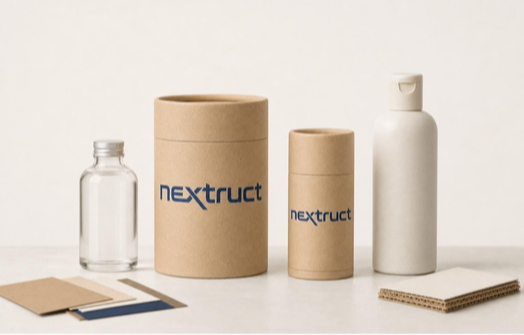
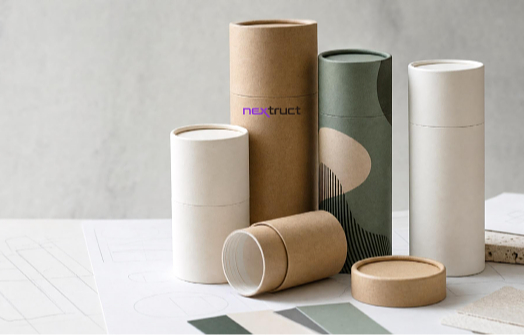
Nextruct’s catalogue shows several paper-container use cases rather than one interchangeable “eco” format. It lists a custom paper supplement tube for formats such as sachets and tablets, and a paper cylinder designed around a glass perfume bottle. The latter illustrates how a paper container may work as a protective outer pack while the glass bottle remains the product-contact pack.
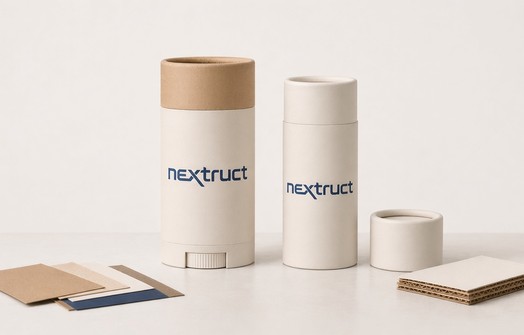
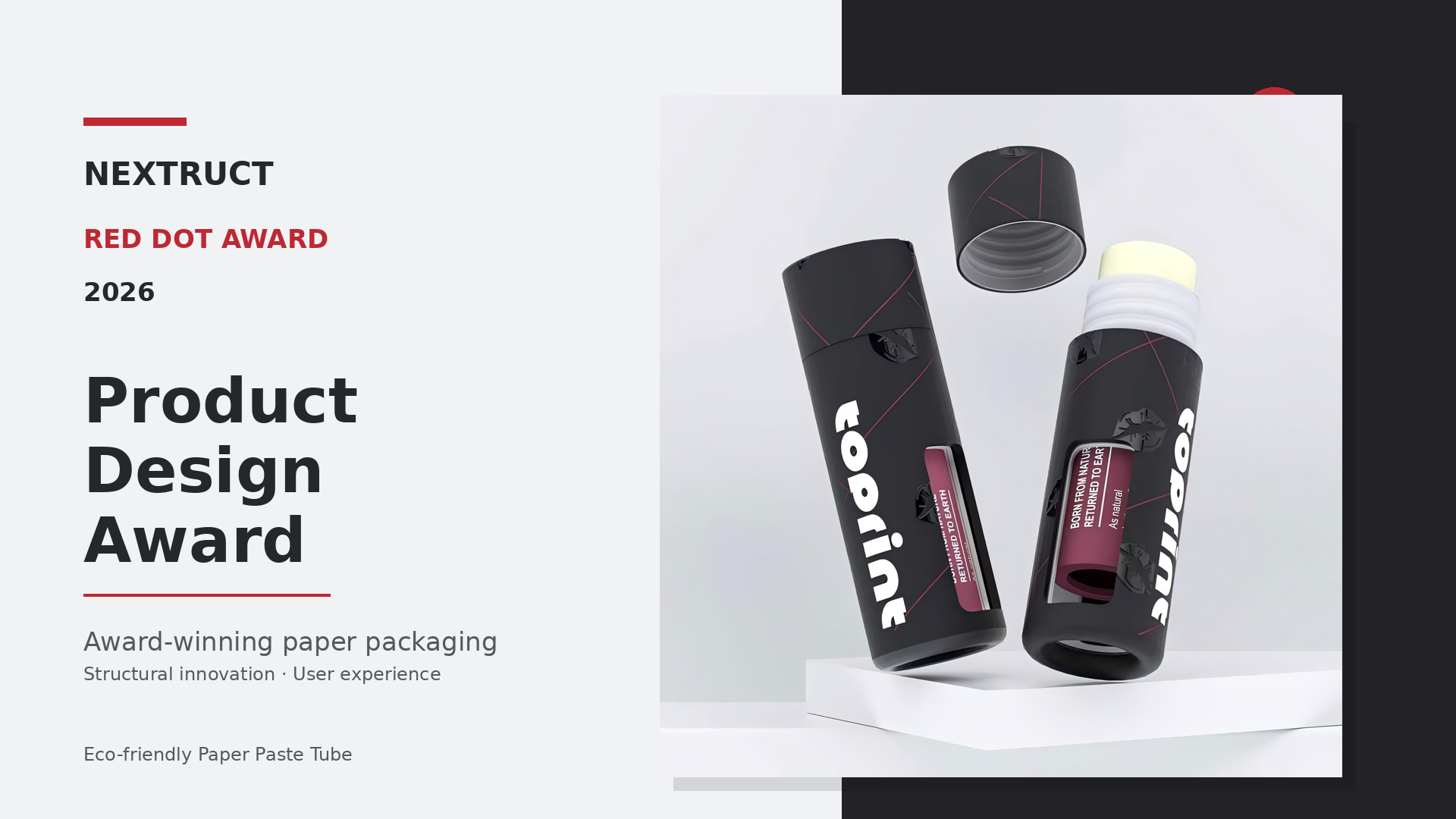
For solid personal-care products, Nextruct also lists a kraft paper deodorant tube with a PCR-PP component. That hybrid example makes the material-stack question concrete: buyers should verify the exact paper and plastic parts, formula compatibility, closure operation, required documents and local end-of-life route for the chosen version. Product-page descriptions are starting points for a specification discussion, not project-specific performance guarantees.
For a paper-container project, a practical sourcing sequence is:
- Map the pack’s role—primary, secondary or both—and identify the markets where it will be sold.
- Agree the target structure and claims, then request a component-level material breakdown and supporting documents.
- Test samples with the intended contents, filling process, closure and distribution conditions; track any change to the approved sample.
- Confirm the final bill of materials, artwork, inspection criteria and shipment documents before production release.
This approach keeps the decision anchored to the package a buyer is actually sourcing. Reuse, recyclability, recycled content and paper substitution are separate design questions; one material label cannot answer all four.
Frequently asked questions
Are reusable cup schemes still mandatory in New South Wales?
No. The NSW EPA’s 28 October 2026 statement says it will not enforce the proposed mandatory reusable-cup scheme. The remaining cup measures are specific to NSW; check the current EPA guidance and effective dates before advising a business or changing packaging.
Are single-use takeaway coffee cups banned in NSW?
No. The cited 2028 measure is that single-use takeaway cups must be recyclable, while businesses must accept clean customer-supplied reusable cups. The policy change does not amount to a general ban on takeaway cups.
Does a paper-based package tested to CEPI/4evergreen v2 automatically recycle in Australia?
No. That is the evaluation framework cited for the reported European secondary-packaging trial. Confirm the Australian collection, sorting and recycling route for the exact paper grade, coating, adhesive and other components.
Does a higher recycled-content percentage make one pack better for every product?
Not on its own. Buyers still need to assess product protection, quality requirements, component compatibility, supply evidence, transport and local end-of-life options. The Pact–ALDI figures describe a defined bottle programme, not a transferable guarantee for other packs.
What should a buyer validate before adopting a paper tube or canister?
Check the full material stack, dimensions and closures, product contact or inner-pack arrangement, filling and dispensing needs, moisture or oil exposure, transit handling, documentation and local recovery pathway. Use representative samples and confirm the approved configuration before production.
Which Nextruct paper containers could be relevant to an Australian project?
The catalogue includes paper supplement tubes, paper cylinders paired with glass fragrance bottles, and paper-bodied deodorant tubes with PCR-PP components. The right format depends on the product and project specification; confirm the exact structure, sample performance, documents and destination-market requirements with Nextruct.